

Classical Pilates Mat Work: Why These Exercises Are Harder Than They Look
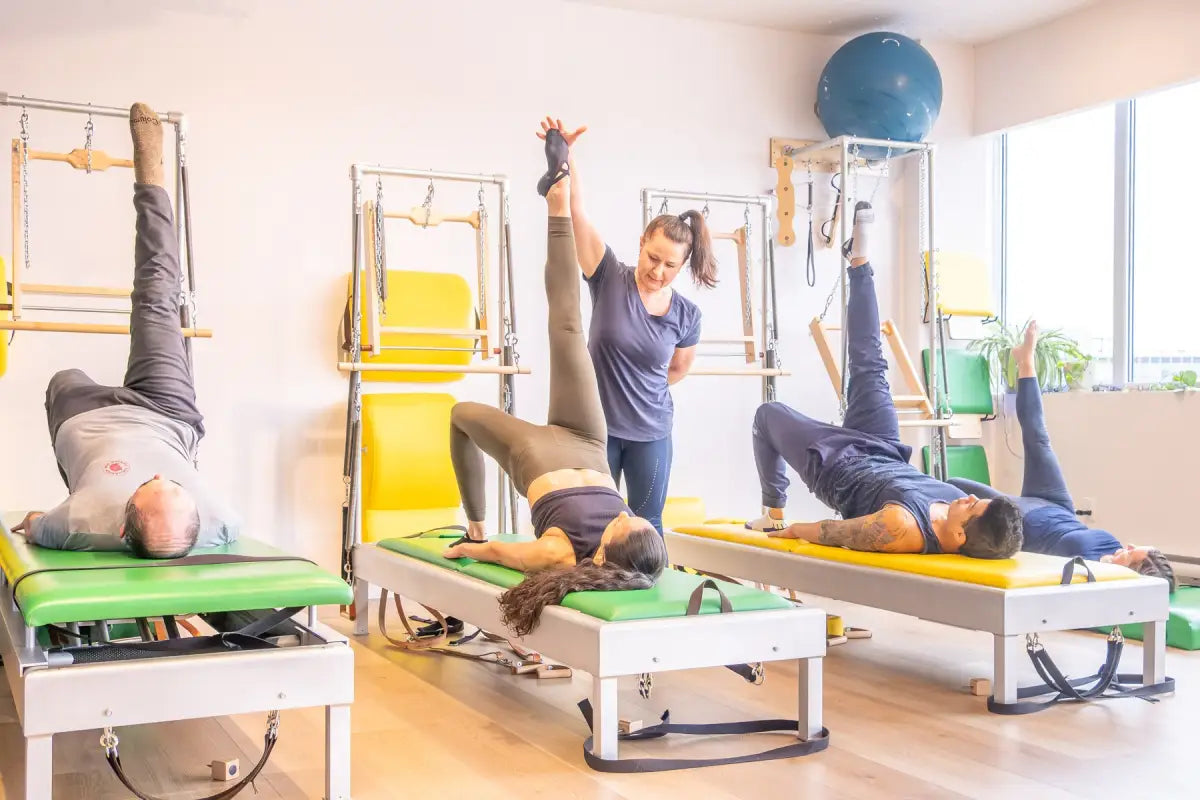

Written by Kasia Frejlich-Morisseau
Today, when people talk about Pilates, many immediately think of the Reformer.
Images of elegant Apparatus with Springs have become extremely popular. Yet, in the original method developed by Joseph Pilates, the work on the Pilates Mat, known as Classical Pilates Mat work, holds a central place.
The Mat is not simply a simplified version of Pilates.
On the contrary, it often represents one of the most demanding parts of the system.
Pilates Mat Work Without External Support: Strength, Stability, and Control
On the Apparatus of the Pilates system, the Springs play an essential role.
They can guide movement, provide progressive resistance, and sometimes offer support to the body during an exercise.
On the Pilates Mat, this assistance disappears.
The body must learn to:
- Organize itself.
- Stabilize.
- Generate strength.
- Control movement.
The body must rely entirely on itself, using its internal organization alone to initiate and sustain movement. This is what makes Mat Work so interesting, in daily life, we do not have springs to support us. The body must be able to stabilize, strengthen, and protect itself. Pilates Mat work develops precisely this capacity.
The Pilates Mat as a Test of Body Organization
Working on the Mat quickly reveals how the body truly organizes itself in movement.
Without the assistance of Springs, it becomes much harder to hide certain compensations. The stability of the pelvis, the organization of the center, the mobility of the spine, and the coordination between different parts of the body all become more apparent.
But in the Pilates system, this challenge is not a limitation.
It is part of the learning process.
Joseph Pilates created the apparatus specifically to help the body develop the strength, alignment, and understanding of movement necessary to perform the Pilates Mat exercises with greater control and precision. In this way, Mat work becomes a true expression of the body’s organization.
The Relationship Between Strength and Mobility

Pilates Mat work highlights the important relationship between:
- The strength of the center.
- The mobility of the spine.
- The organization of the limbs.
Take the Roll Up, one of the most well-known exercises in the Classical Pilates repertoire. The difficulty does not come only from flexibility. It often comes from the ability to organize the center of the body while allowing the spine to articulate smoothly and progressively.
In Classical Pilates, strength and mobility do not oppose each other. They work together to create movement that is controlled, fluid, and efficient.
The Classical Pilates Mat with a Foot Strap
In Classical Pilates, the Classical Mat always includes a foot strap.
This Strap helps to:
- Anchor the legs.
- Organize the pelvis.
- Support activation of the center.
- Facilitate certain spinal articulations.
In exercises such as the Roll Up, it can help develop:
- Connection to the powerhouse.
- The lengthening of the legs in relation to the powerhouse.
- The progressive articulation of the spine.
The Strap is not there to make the exercise easier.
Rather, it helps the body understand certain fundamental organizations of movement, which can later be performed without assistance.
The Pilates Mat Insert Handles
The Classical Mat also includes the Mat Insert Handles.
Unlike modern exercise mats that are simply placed on the floor, the Insert Handles are part of the original design of the Pilates Mat. They offer interesting possibilities for developing connections in the upper body and into the powerhouse.
By pulling or pressing on the Mat Insert handles, it is possible to:
- Find a deeper connection in the upper back.
- Organize the shoulders.
- Create more length in the spine.
In certain back extension exercises — such as variations related to Swan — the Mat Insert handles can help explore a more dynamic extension while maintaining strong support in the back.
Pilates Mat Work in the History of Pilates
Mat Work occupies a fundamental place in the history of the Pilates method.
In 1945, Joseph Pilates published his book Return to Life Through Contrology, in which he presented a series of 34 mat exercises. These exercises form the foundation of the classical mat repertoire.
Joseph Pilates recommended practicing them regularly to:
- Strengthen the center of the body.
- Improve posture.
- Develop spinal mobility.
- Restore vitality to the body.
He explained that these exercises could be practiced almost anywhere with minimal equipment, making the method widely accessible.
However, in his New York studio, the work was never limited to the mat alone.
Mat Work was always part of a much larger system, including the apparatus Joseph Pilates invented to help the body develop what Romana Kryzanowska often described as strength, stretch, and control.
Demanding Work, Deeply Formative

From the outside, Mat Work can sometimes appear simple, the movements may look small and not much seems to happen visibly, but in Classical Pilates, a great deal is happening inside the body.
The exercises require:
- Precision.
- Control.
- Coordination.
- Engagement of the center (the powerhouse).
- Mobility of the spine.
Every movement begins from the center and requires a very specific organization of the body. When an exercise is performed correctly, the effort does not come only from the arms or legs, but from a deep connection to the powerhouse.
This is why the exercises can appear simple to observe… yet feel much more demanding to perform. Pilates Mat work therefore becomes a powerful way to develop a deeper understanding of movement.
The Mat Within the Pilates System
In Classical Pilates, Mat Work is never isolated.
It is part of a complete system that includes the apparatus — Reformer, Cadillac, Barrels, and Chairs — each designed to develop different qualities of movement. The apparatus can guide certain sensations, create resistance, and help develop stability.
The Pilates Mat then asks the body to integrate these qualities independently.
For this reason, Mat Work remains an essential part of:
- Classical Pilates practice.
- The progression of students.
- The training of Pilates instructors.
The Enduring Importance of Classical Pilates Mat Work
Classical Pilates mat work may appear simple from the outside, yet it demands a remarkable level of organization, control, and strength.
Without the support of springs or external assistance, the body must learn to stabilize, coordinate, and generate movement from within. The work develops deep strength, particularly through the powerhouse, while maintaining mobility and precision throughout the body.
When practiced as part of the complete Pilates system, mat work becomes a powerful way to build a strong, balanced, and intelligently organized body.
This is why it continues to hold a central place in classical Pilates practice and in the training of future instructors.
About Kasia Frejlich-Morisseau

Kasia (Katarzyna) Frejlich-Morisseau has devoted nearly twenty-five years to teaching movement and improving quality of life through bodywork. After studying marketing, she trained in fitness and quickly began teaching various movement disciplines. Early in her career, she discovered Pilates and became deeply interested in the method’s precision and its holistic approach to the human body. Her journey first led her to explore different contemporary approaches to Pilates. However, as she deepened her practice and teaching, she felt the need for a more complete and coherent understanding of the system. She found this clarity within Classical Pilates, where each exercise and each piece of equipment is part of a structured and interconnected system. Kasia then pursued further training in the full Pilates system.
She completed the Bridge Program with Real Pilates in New York, a program created by Alycea Ungaro, a student of Romana Kryzanowska, who was herself a protégé of Joseph Pilates. This training allows her to teach the Pilates system in alignment with its original work and places her within the third generation of Pilates teachers.
In 2025, she continued to deepen her knowledge of the classical system by studying The Classical Syllabus with MeJo Wiggin, also trained by Romana Kryzanowska.
She teaches the complete Classical Pilates system, both on the mat and on all traditional apparatus, including the Reformer, Cadillac, the various chairs (Wunda Chair, Baby Chair, Arm Chair, High Chair), as well as the Barrels and other apparatus that are part of the classical system.
Driven by a constant desire to deepen her understanding of the human body, Kasia also completed one year of studies in physiotherapy, which enriched her knowledge of anatomy and pathology.
Her international career began in Poland, continued for eleven years in France, and later developed in Canada, where she settled in 2019.
She is now the founder of Pilates AuthentiKa, a studio located in Saint-Lambert, in the Montérégie region near Montreal.
At her studio, she teaches Classical Pilates in a professional and demanding environment, while supporting clients in developing strength, mobility, and body awareness.
Alongside the development of her studio, Kasia designs and leads professional training programs for future Pilates instructors, sharing her vision of a rigorous, authentic teaching approach rooted in the classical system.
Leave a comment
Comments will be approved before showing up.