

The Missing Link Between the Feet, Powerhouse, and Intelligent Footwork

Written by Kasia Frejlich-Morisseau
What I love most about the Pilates method is that it never neglects the feet.
On the contrary, Pilates is demanding when it comes to foot strength, ankle stability, and mobility. The feet are not decorative. They are structural, functional, and deeply connected to the powerhouse.
And this is exactly where the Foot Corrector becomes a quiet ninja.
Why I Love Using the Foot Corrector Before Footwork
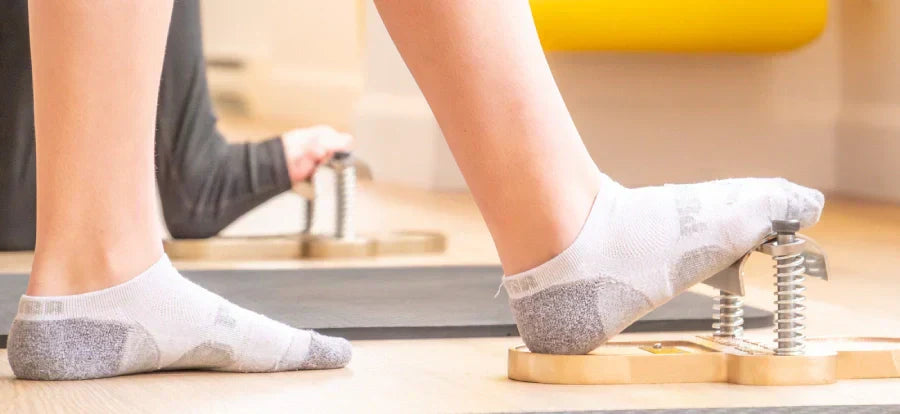
Personally, I love using the Foot Corrector before going onto the Reformer.
Standing, facing the mirror, without the distraction of a moving carriage, I can immediately observe:
-
The alignment between the foot, the knee, and the hip
-
How the pelvis organizes above the feet
-
How weight is distributed between the inner and outer edges of the foot
This standing work using the Foot Corrector creates clarity before Footwork on the Reformer.
Instead of searching for alignment once the body is already lying down, the work begins where movement truly starts: the feet.
Strengthening the Arch According to Position and Intention
The Foot Corrector allows us to strengthen the plantar arch in a very intelligent way.
Depending on the position, heel, arch, or toes the body is asked to:
-
Organize the foot without collapsing
-
Align the foot with the knee and hip
-
Absorb resistance through the abdominals rather than pushing mechanically
This is not just about foot strength. It is about functional alignment.
The springs on the Foot Corrector give immediate feedback: if the arch collapses, if the knee drifts, if the pelvis shifts, the body knows.
Balance, Strength, and Mobility — All at Once
Because the Foot Corrector is powerful, it naturally develops:
-
Balance through aligned support
-
Strength without rigidity
-
Mobility without loss of control
By finding a balanced, organized support through the foot, the practitioner improves their ability to stand with more ease, walk with better coordination, and jump with more efficiency and safety
This is Classical Pilates at its best: strength and flexibility working together.
Foot Corrector Springs Provide Honest Feedback
The strong springs of the Foot Corrector are not meant to be conquered. They are meant to be absorbed.
They invite the body to lift the deep abdominals, create space in the hips, and organize the legs from the center rather than forcing the movement from the extremities.
For some people, this is a revelation. For others, it is challenging at first, especially if they are not used to initiating movement from the powerhouse.
But that challenge is precisely what makes the Foot Corrector such a refined tool.
How the Foot Corrector Helps Create Clearer, Smarter Footwork
After working on the Foot Corrector, Footwork on the Reformer often feels very different:
-
Feet are more awake
-
Arches are more responsive
-
Alignment on the Footbar is easier to maintain.
The connection between the feet and the powerhouse is clearer, the legs feel more organized, and the movement becomes more efficient. This is not because of effort, but because of integration.
About Kasia

Kasia Frejlich-Morisseau is the founder of Pilates AuthentiKa and a third-generation Classical Pilates teacher with over twenty years of experience in movement and bodywork. Her journey into Pilates began alongside her studies in marketing, quickly becoming a lifelong passion. After first exploring contemporary Pilates, she pursued Classical training through The Bridge program with Real Pilates, rooted in the original work of Joseph Pilates and the lineage of Romana Kryzanowska. Kasia completed one year of physiotherapy studies, then decided to discontinue the program after moving to France. Her intention was to deepen my understanding of anatomy and pathology, rather than to pursue a clinical career, as she has always been drawn to the field of well-being.
Having taught in Poland and France before settling in Montreal in 2019, Kasia brings an international perspective to her teaching. In 2017, she became a certified Professional and Personal Coach in Paris, integrating coaching principles into her Pilates practice to support both physical and personal development. Known for her warmth, energy, and thoughtful approach, Kasia is committed to helping her clients build strength, awareness, and a respectful connection to their bodies. She teaches in French, English, and Polish. In 2026, Kasia will be offering a comprehensive 600-hour Classical Pilates Teacher Training Program, covering the full Pilates system, at her studio in Québec, Canada.
Leave a comment
Comments will be approved before showing up.