

The Foot Corrector: Small Apparatus, Big Impact

Written by: Allie Lochary Ceresnak
"I've been wondering what that was!"
That’s the response I most often hear when introducing someone to the Foot Corrector. Frequently tucked away in the corner of a studio, this small apparatus directly addresses one of the most important (and often neglected) areas of the body: the feet.
Joseph Pilates designed the Foot Corrector to strengthen the feet and correct alignment throughout the lower extremities. In fact, it was the first apparatus to receive a patent, officially recognized on May 4, 1923.
Design and Benefits of the Pilates Foot Corrector
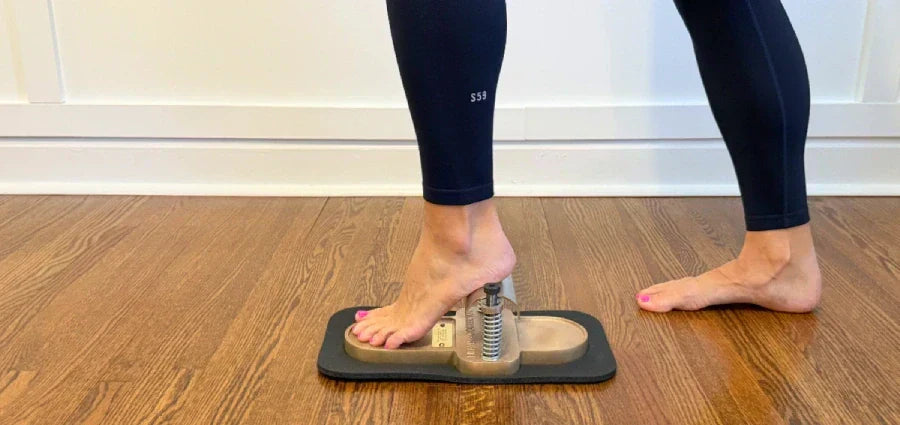
Simple in design, the Foot Corrector consists of a solid base and two springs connected to a saddle shaped like the arch of the foot. Pressing down on the saddle against spring resistance offers targeted benefits that extend far beyond the feet:
- Develops intrinsic foot strength
- Corrects rolling in or out
- Improves ankle mobility
- Enhances balance and proprioception
- Builds a strong connection between the feet and the powerhouse
Having a strong foundation improves function not only inside the Pilates studio, but in the way we stand, walk, and move through daily life.
Connecting the Feet to the Powerhouse

Because the Foot Corrector is used unilaterally, it allows both instructor and student to clearly recognize asymmetries. Students are often humbled by the realization that their feet may not be as strong as they thought, or by the noticeable imbalance between their right and left sides.
Developing this awareness is often a turning point.
I recently asked one of my clients for her thoughts on the Foot Corrector at the end of a session, and her answer was music to my ears. She shared that it helped her feel the connection between her feet and her seat, especially on the Reformer. More importantly, it gave her a clearer understanding of how to actively use her feet rather than simply placing them somewhere.
This is where the Foot Corrector becomes far more than a strengthening tool — it becomes an integration tool.
The connection between the feet and the powerhouse is, in my experience, one of its most powerful benefits. All of the smaller Pilates apparatus and accessories exist to help students deepen connections across the Pilates system. When a student learns to actively engage the feet, the entire body responds differently.
When I incorporate the Foot Corrector into a session, I consistently reference it in my cueing on other apparatus. During Footwork on the Reformer, for example, I’ll ask a student to think of the footbar as the saddle. With that simple reminder, they immediately feel their inner thighs, glutes, and abdominals engage without any additional cueing.
Putting this Pilates Accessory Into Practice

Notice what changes, not just in the feet, but your overall awareness.
Explore how the work translates into exercises such as:
- Footwork and Long Stretch Series on the Reformer
- Shoulder Roll Down and Tower on the Cadillac
- Going Up Front and Table on the Wunda Chair
…the list truly goes on.
I often begin a client’s session with Foot Corrector work, or incorporate it when transitioning between apparatus. It’s a powerful tool that requires very little time or space, yet delivers big results.
If time is limited, two Foot Press variations can be remarkably effective:
Foot Press: Balls
Stand behind the Foot Corrector and place one heel on the base with the ball of the foot on the saddle. Keeping the working leg slightly bent, as if in a small lunge, press the saddle down and hold for three counts. Release with control. Focus on keeping your weight centered between the big toe and pinky toe.
Foot Press: Heels
Flip the Foot Corrector around and place the ball of the foot on the base with the heel centered on the saddle. With a slight bend in the working leg, press the saddle toward the floor and hold for three counts. Release with control. Concentrate on activating the glute of the working leg.
The benefits of the Foot Corrector extend far beyond strengthening the feet. When the foundation becomes stronger, alignment improves, connections deepen, and the entire body functions more efficiently.
Carve out a few minutes to use the Foot Corrector in your next session, and remember: if you want a strong seat, start with your feet!
About the Author

Allie Lochary Ceresnak discovered Pilates while living in New York City as a professional modern dancer. Although she had used Pilates as conditioning throughout high school and college, it wasn’t until one transformative class that everything clicked.
She received her comprehensive certification from Core Pilates NYC, where she later served as a Teacher Trainer, and went on to become a Lead Teacher Trainer for the Equinox Pilates Institute.
With over 15 years of experience, Allie now resides in Charlotte, NC, where she teaches private sessions out of her home studio. Connect with her on Instagram.
2 Responses

Leave a comment
Comments will be approved before showing up.
Gratz Pilates
May 22, 2026
Hi Yoshiko! Wishing you the best of luck during your Classical Pilates studies. We recommend utilizing Pilatesology to see how the Foot Corrector is used in practice, and you can follow along with classes virtually as well. They offer classes in many languages to accommodate individuals around the world.
Please let us know if you have any other questions!