

Discovering the Vertical Line Through the Pilates Chairs
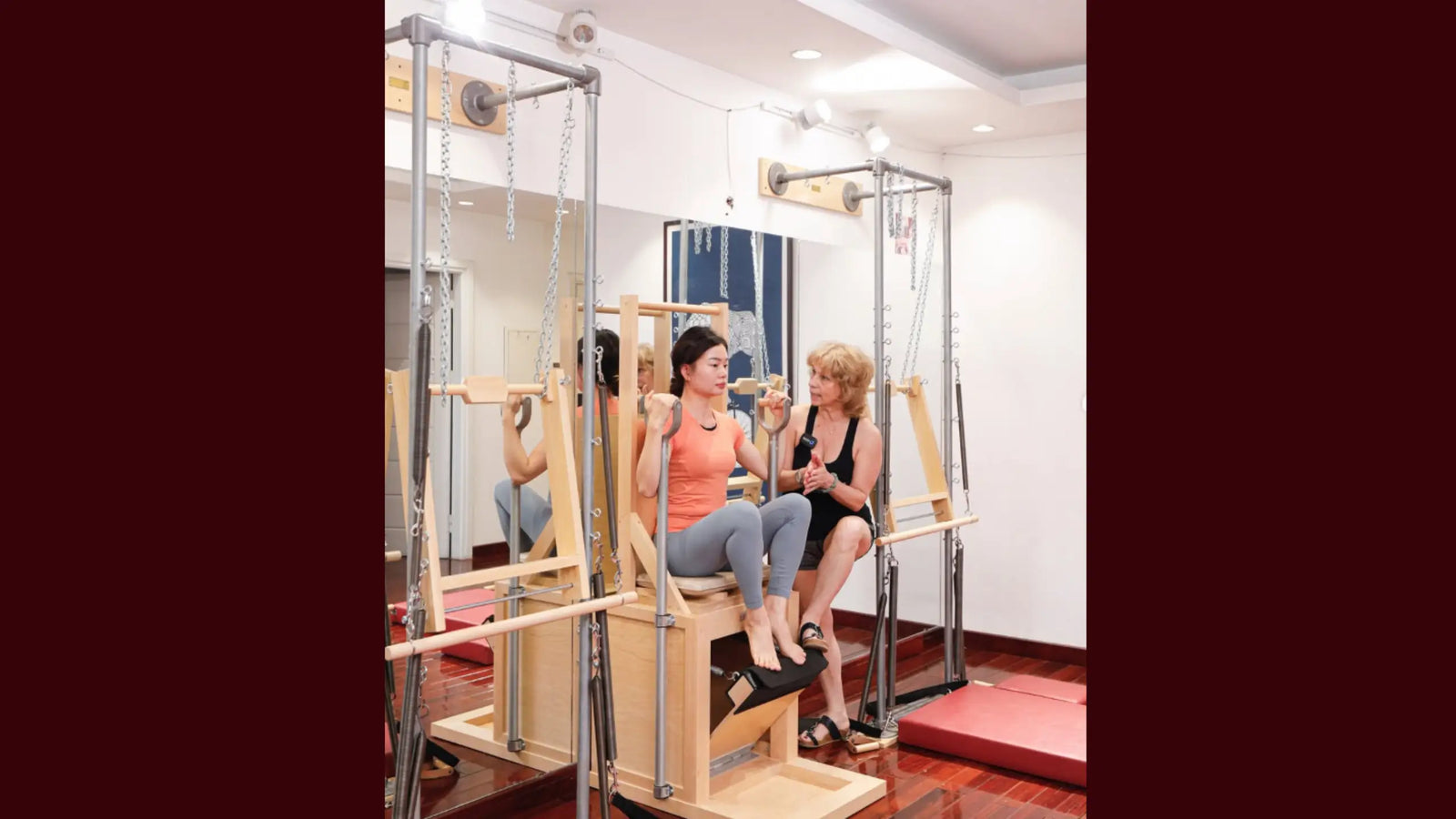

Photo via The Art of Control Pilates
Written by Simona Cipriani
At Gratz, we’re fortunate to work with many of the world’s great Classical Pilates teachers. One of them is Simona Cipriani, founder of Art of Control Pilates and a longtime advocate for the traditional Contrology method. Simona’s journey to Pilates began in the world of professional dance. Born in Italy, she began dancing at a young age and went on to perform internationally for decades. Like many dancers, she discovered Pilates as a way to strengthen and sustain the body, but the method quickly became much more than conditioning. After moving to New York, she studied directly under Romana Kryzanowska at the historic Drago’s Gym studio and became deeply immersed in the classical method.
Over the past three decades, Simona has become one of the most respected teacher-educators in Classical Pilates, known for her deep understanding of the system and her ability to communicate the intelligence behind Joe Pilates’ work. Through her studio and teacher training program, she has trained teachers from around the world while continuing to teach workshops internationally. We’re proud to have Simona as a Gratz Ambassador, and in the article below she shares her perspective on one of the most important ideas in the Pilates method—the vertical line of forces, and how the chairs reveal this concept in a powerful way.
- John Riccitiello, Co-Owner of Gratz Pilates
Understanding the Vertical Line
By: Simona Cipriani
One of the ideas I love most in the Pilates method is what I call the "vertical line of forces".
When the body organizes itself along this vertical pathway, from the feet, through the pelvis and spine, all the way to the crown of the head, something beautiful happens. The body becomes lighter. Movement becomes clearer. Balance feels natural.
Joseph Pilates designed his work so that we learn to cooperate with gravity rather than fight it. When we understand this relationship, the body begins to move with more intelligence and ease.
For me, some of the clearest lessons about this vertical organization come from working on the chairs: the Wunda Chair, the Electric Chair, and the Small Arm Chair (Baby Chair).
Each of these pieces of apparatus reveals something unique about how the body connects to the ground and lifts upward at the same time.
The Wunda Chair: Finding Lift
The Wunda Chair is one of the most powerful teachers in the studio.
At first glance it looks simple, but once you begin working on it you immediately feel the relationship between the pedal, the springs, and the pelvis. The body begins to understand how pressing down through the limbs can create lift through the spine.
Exercises like Pumping, Mountain Climb, or Balance Control Front require us to organize ourselves vertically. If we collapse, the exercise becomes heavy and unstable. But when the body finds that central line, everything changes. The spine lengthens, the pelvis lifts, and the body feels as if it is rising upward, even as the pedal moves downward.
This beautiful paradox is one of the great insights Joseph Pilates built into his apparatus.

The Electric Chair: Stability and Ascent
The Electric Chair brings another dimension to the vertical line.
Because the back is supported, students can feel more clearly how the spine stacks and how the pelvis organizes itself underneath. The pedals provide immediate feedback about weight distribution through the feet.
When practicing exercises such as Going Up Front, the springs coming from underneath encourage the body to lift through the center while the legs support and transfer weight.
Over time this awareness carries into everyday life. Something as simple as climbing stairs becomes smoother, more efficient, and more graceful.

The Baby Chair: Precision and Awareness
The Small Arm Chair (Baby Chair) is often underestimated, but it is an extraordinary teacher.
Its smaller structure and lighter springs require precision. The body cannot rely on large movements or momentum. Instead, the deeper postural muscles awaken.
The angle of the back support helps students discover the position of the pelvis and the length of the spine. Even the actions of the arms and shoulders connect directly into the center of the body.
On this chair the work becomes quiet, refined, and very powerful.
Why the Apparatus Matters
Joseph Pilates designed his Apparatus with remarkable intelligence. The springs, proportions, and angles guide the body toward better organization and alignment.
When the Apparatus responds clearly, students can feel the dialogue between the body and the springs.
This is one of the reasons I value working on Apparatus from Gratz Pilates. The dimensions and spring resistance reflect the traditional designs that allow the exercises to communicate clearly to the body.
For both teachers and students, that clarity is essential.
Experiencing the Vertical Line
When we work on these Pilates chairs, we begin to experience how energy travels through the body:
• From the feet
• Through the pelvis
• Along the spine
• To the crown of the head
With practice, the body develops:
• Strong core support
• Responsiveness to gravity
• Balance and coordination
• A sense of lift without tension
This is the beauty of Contrology. Through precise work on the Apparatus, the body becomes both grounded and uplifted at the same time.
For me, the chairs are a powerful reminder of Joseph Pilates’ genius—and of how the right apparatus can help students discover the elegance and intelligence of the method.
Simona Cipriani
Founder, Art of Control Pilates
Gratz Ambassador
Leave a comment
Comments will be approved before showing up.