

How the Pilates Reformer Doesn't Let You Cheat
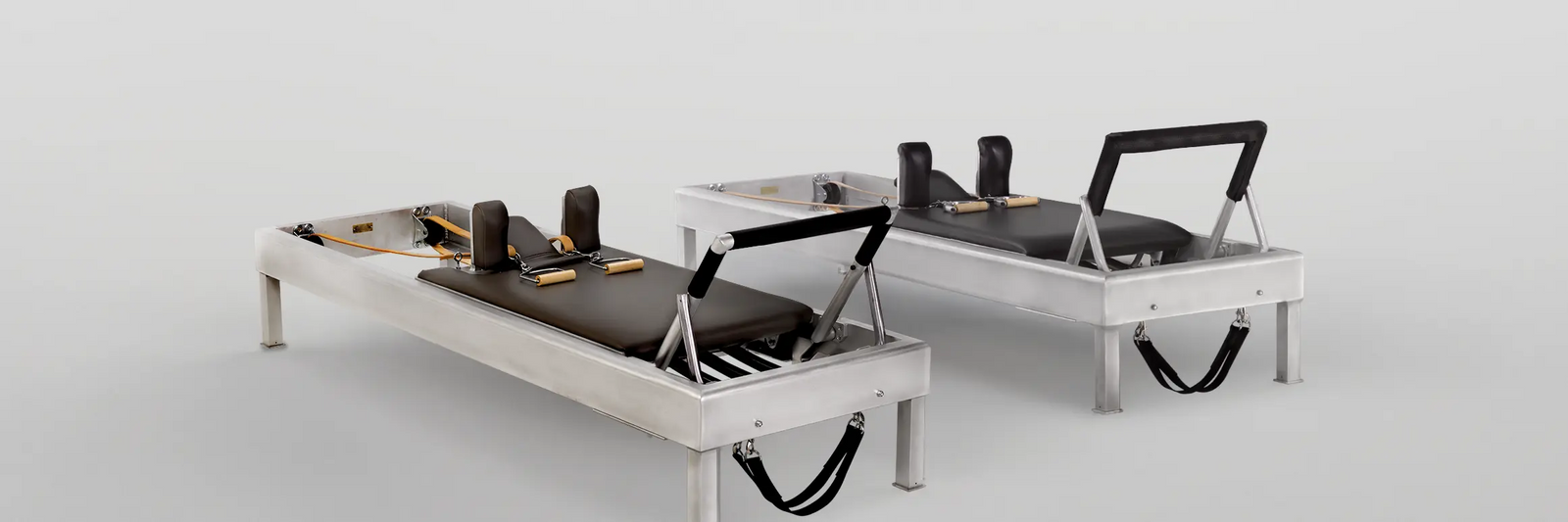

The Reformer has been trusted by teachers and practitioners who believe the apparatus should do more than support movement—it should teach it.
That teaching happens through honesty.
The Gratz Reformer doesn't disguise imbalance. It doesn't smooth over inconsistencies or allow momentum to replace control. Instead, it reflects exactly what the practitioner brings to the exercise. Every spring, every transition, and every inch of carriage travel provides immediate feedback.
Not to criticize, but to educate.
That distinction is what has made the Reformer the centerpiece of the Pilates system for generations.
The Pilates Apparatus Was Never Meant to Do the Work
One of the most common misconceptions about Pilates is that the apparatus assists the body.
In reality, Joseph Pilates designed his equipment to challenge it.
The Reformer isn't intended to carry you through an exercise. It asks you to organize your body before the movement begins and continue that organization until the exercise is complete. The carriage moves because you create balanced movement. The springs respond because you've earned that response.
Nothing happens accidentally.
That relationship is what makes the Reformer so different from conventional exercise equipment. Instead of isolating muscles or adding resistance for resistance's sake, every element works together to improve how the body functions as a whole.
Each repetition becomes an opportunity to refine awareness, coordination, strength, flexibility, rhythm, and control—not as separate goals, but as qualities that develop together.
How Feedback in Pilates Is the Greatest Teacher
Good teachers know that feedback is essential. The Reformer offers it constantly.
- Lean too heavily into one side, and you'll feel it.
- Rush a transition, and the carriage will tell you.
- Lose your connection to the center, and the springs respond differently.
The apparatus doesn't correct you. It simply reflects what happened. That immediate conversation between body and apparatus is one of the reasons practitioners continue discovering new lessons decades into their practice.
An exercise doesn't become easier because you've done it a thousand times. It becomes more revealing.
- The Hundred begins to teach breathing in a different way.
- Footwork becomes a lesson in balance rather than legs.
- Long Stretch becomes less about strength and more about connection.
- Snake becomes less about flexibility and more about organization.
The choreography may remain the same, but the understanding never does.
Precision Creates Freedom
Classical Pilates is highly structured:
- Every exercise has a purpose.
- Every spring setting has intention.
- Every transition matters
That structure isn't limiting, it's what creates freedom. When movement is organized, the body becomes capable of:
- Greater mobility.
- Greater efficiency.
- Greater confidence.
- Greater ease.
The Gratz Reformer encourages practitioners to find that freedom through precision rather than compensation. Instead of allowing the body to work around weaknesses, it continually invites those weaknesses to become strengths.
Sometimes that means slowing down, sometimes it means doing less. Often, it means returning to the fundamentals with a deeper understanding than before.
Why Pilates Teachers Keep Coming Back
Ask experienced Classical teachers why they continue practicing on a Reformer after twenty, thirty, or forty years, and you'll rarely hear them describe the apparatus itself.
They'll describe what it continues to teach them:
- No one ever finishes learning Footwork.
- The Long Stretch Series continues to evolve.
- The seemingly simplest exercises often become the richest studies in control.
That is one of the remarkable qualities of Joseph Pilates' system. The method grows because the practitioner grows. The Gratz Reformer simply continues telling the truth. It doesn't change to accommodate the practitioner. Instead, the practitioner changes through the work.
A Teacher's Perspective: Rediscovering the Reformer

The Reformer continues to reveal new lessons throughout a lifetime of practice. Classical Pilates teacher Olivia Obregon experienced that firsthand when she returned to a Gratz Reformer after several years of working exclusively on contemporary equipment.
"I still remember the first time I got on a Gratz Reformer after a few years of exclusively working on contemporary equipment. I thought I knew what to expect. Instead, every exercise felt completely different, in the best possible way. I could feel how each movement originated from my center in a way I hadn't quite felt before. It was far from subtle. It was the kind of difference that makes you sit up and pay attention. The apparatus isn't just exercise equipment—it's a piece of design that Joseph Pilates really got right the first time.
The Reformer is the carriage, springs, and a sturdy frame. The simplicity of Gratz is the whole point: the springs give you resistance that is honest, the tension you can feel and adjust with your own hands. You push it, it pushes back, and your body has to organize itself in response. That's the entire method in one sentence!
The Reformer asks a lot of you. It may look passive, but the carriage does not lie. If your alignment is off, if one side is working harder than the other, if you're bracing versus stretching, you feel it immediately.
I own a Classical Pilates studio in Miami and rely on Gratz for my clients. I didn't arrive at that decision casually. Through years of working with fantastic mentors and learning and teaching this method, it became clear there is no other way to do this. You can't separate the method from the apparatus it was designed on.
Our clients clearly notice the difference even when they can't articulate why. I love that we can offer them choices, as we have a range of Gratz Reformers. I have all lengths: 80", 86", and 89"along with both Universal and Archival models. Clients develop favorites, but we often prescribe a Reformer based on what their body needs that day. You get a level of thoughtfulness that you don't get with other companies making one-size-fits-all products.
My advice to those who really love Pilates is simple: get yourself on a Gratz Reformer at least once. Feel what the spring tension is supposed to feel like. Notice how the carriage responds to you instead of the other way around. It changes how you think about what exercise equipment is truly for."
Preserving a Language in Classical Pilates
Every discipline has a language. For example:
- Music has notation.
- Dance has technique.
- Pilates has its apparatus.
When teachers around the world work on Reformers built to the same proportions, responding with the same relationships between springs, carriage, and frame, they are speaking a common language.
It is one of the reasons the Classical Pilates community has remained connected across generations.
More Than a Piece of Equipment
The Gratz Reformer has never been defined by the materials it's made from or the craftsmanship that goes into building it—though both matter deeply. Its true significance is found in the experience it creates.
Every time a practitioner steps onto the carriage, they begin the same conversation that has shaped generations of teachers and students before them. The apparatus doesn't provide answers; it asks questions. Are you moving with intention? Are you connected? Can you find more precision, more control, more ease?
The remarkable thing is that those questions never stop. The exercises remain the same, yet the understanding continues to deepen. What once felt like strength becomes coordination. What once felt like effort becomes efficiency. The work doesn't change; the practitioner does.
That is the enduring role of the Gratz Reformer. Not to perform the movement for you, but to reveal it more clearly each time you return.
Leave a comment
Comments will be approved before showing up.