

Build a Better Body with the Pilates High Chair
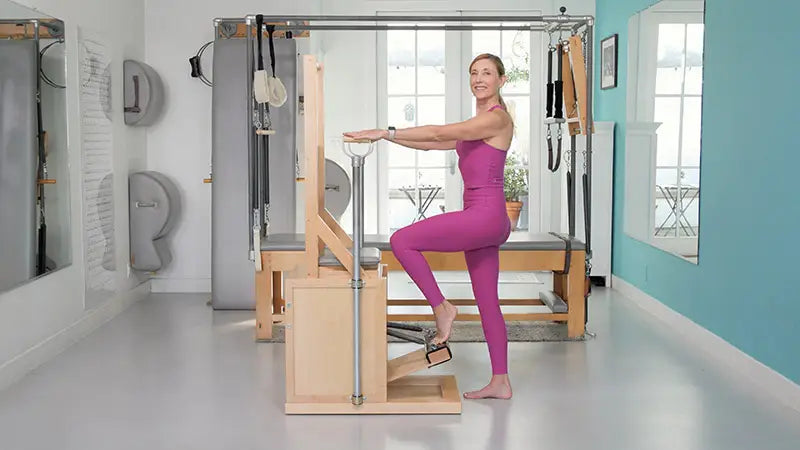

Photo Via Pilatesology
Written By: Alisa Wyatt
Near the end of one of my early Pilates lessons, my teacher Romana Kryzanowska led me over to a chair that looked just like an Electric Chair you might see at an execution and she said to me: “This is the chair, and you are the electricity!”
I giggled, climbed on and within a few pumps of the pedal, I knew exactly what she meant. The High Chair as it’s formally called, uses the heaviest Springs in the studio to make you strong as an ox. You truly feel your energy and power rise with every repetition. On your 3rd or 4th workout you’ll wonder if someone changed the springs to a lighter setting, that’s how much stronger you will be.
Why the Pilates High Chair Matters
The High Chair gives us a rare combination: support and challenge at the same time.
Because you’re upright and often holding onto the handles, your body feels more stable. That stability creates an opportunity — especially for students who need to build strength, recover from injury, or understand alignment more deeply.
From there, the work becomes incredibly precise:
-
The legs learn to press evenly
-
The hips organize and stabilize
-
The spine lengthens and lifts
-
The upper body connects instead of compensating
A Tool for Every Level
One of my favorite things about the High Chair is how beautifully it meets you where you are — and then keeps evolving with you.
For Beginners: Building Strength Without Strain
A foundational exercise like Pumping is one of the best places to start.
It’s simple in appearance, but incredibly effective:
-
Strengthens the entire lower body
-
Encourages even use of both legs
-
Builds stability through the hips and pelvis
-
Supports those dealing with knee discomfort
It’s one of those exercises that teaches you how to use your legs — not just move them.
Explore it here!
For Intermediate Pilates Students: Control, Balance, and Power
As students progress, the High Chair begins to challenge coordination and balance in a deeper way.
Going Up Front is a perfect example.
This exercise:
-
Develops strength in the hips and glutes
-
Challenges balance and control
-
Reinforces proper tracking of the leg and foot
-
Prepares the body for more advanced Chair work
It’s a stepping stone — literally and figuratively — toward the kind of strength that carries over into everything else.
See it in action: here .
For Advanced Pilates Students: Upper Body Strength & Lift
The High Chair isn’t just about the legs.
At the advanced level, it becomes a powerful tool for upper body strength and spinal flexibility.
The Press Up Back is a great example:
-
Strengthens the arms, shoulders, and back
-
Demands deep core support
-
Encourages lift through the spine rather than compression
-
Challenges control in a very honest way
There’s nowhere to hide in this exercise and that’s exactly what makes it so effective.

What Makes the Pilates High Chair Unique
Unlike the Wunda Chair, which often demands balance right away, the High Chair offers guidance through its structure.
That guidance allows students to:
-
Find alignment before adding complexity
-
Build strength safely and progressively
-
Experience success earlier in their practice
-
Develop confidence in upright movement
It’s especially valuable for:
-
Clients recovering from injury
-
Those with knee or hip concerns
-
Beginners who need feedback and support
-
Athletes who need to reconnect to alignment
A Different Kind of Strength
What I love most about the High Chair is that it doesn’t just make you stronger — it makes you more organized.
Students begin to feel:
-
More grounded through their feet
-
More supported through their hips
-
More lifted through their spine
-
More connected from head to toe
And that carries into everything: walking, standing, climbing stairs, even just being.
For classical teachers, the Gratz High Chair remains the gold standard because it reflects the original design, feel, and function of the apparatus as intended in the traditional Pilates system. Its solid construction, precise pedal action, and carefully calibrated spring tension provide the kind of clear, consistent feedback that teachers rely on. For those committed to preserving and teaching authentic classical Pilates, the Gratz High Chair offers a level of reliability and integrity that’s hard to match.
Continue Learning with Pilatesology
If you’d like to see the High Chair in action and understand how to teach and practice it with clarity and confidence — Pilatesology offers a full library of classical Pilates classes and tutorials.
From beginner foundations to advanced challenges, you’ll find expert guidance to support every stage of your journey.
✨ New to Pilatesology? Use code GRATZ30 for 30% off your subscription and start exploring today.
About Alisa Wyatt

Alisa Wyatt is the co-founder of Pilatesology and a second-generation Pilates teacher who has dedicated her career to preserving and sharing the classical Pilates method.
Known for her warm, accessible teaching style and deep respect for the original work, Alisa helps students and teachers alike experience Pilates as a complete, connected system that supports real life movement.
Leave a comment
Comments will be approved before showing up.