

What Pregnancy Taught Us About the Gratz Reformer
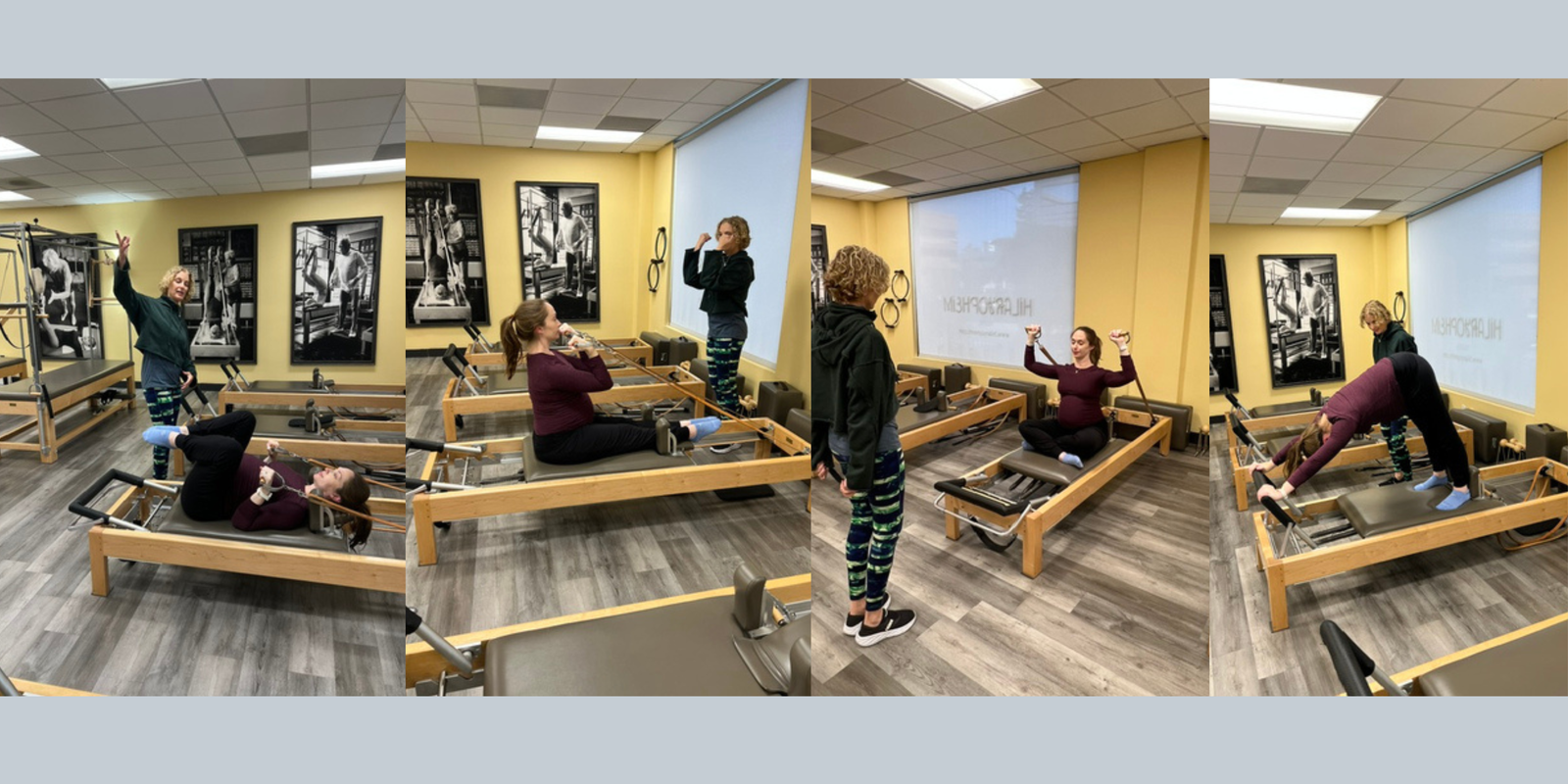

Written by Hilary Opheim & Davita Paul
In our movement and teaching practice, we often describe how the traditional Pilates apparatus "speaks" to the person using it. Traditional equipment doesn't just give you a workout; it highlights the patterns that are happening, or not happening, in the body, giving the mover the immediate feedback they need to feel out what the body requires in that moment. It doesn't force but rather teaches and guides.
We always teach with our guiding philosophy that every body is different and we must always meet the client where they are on any given day. We teach to the body in front of us, and we educate our student teachers and mentees to do the same. Even though both Davita and Hilary had worked extensively with perinatal clients in the past, this shared experience as client and teacher deeply expanded our understanding of the support and feedback available through the traditional apparatus. This journey through Davita’s pregnancy and postpartum recovery deeply opened our eyes to just how profoundly the traditional apparatus supports and guides a traditional Pilates practice through major life transitions.
Training while pregnant became a study of rapid physiological changes, patience, and the raw acceptance of what just isn't possible for now. It was both fascinating and deeply frustrating to navigate what had to be adapted for the time within a lifelong practice.
Finding Support Through the Gratz Reformer
Davita and I have been moving together in the studio since before the 2020 lockdowns. When the world shut down, we had only managed to fit in one single session on our new Gratz Reformers. Like so many people that year, Davita had to pivot and utilize a contemporary home reformer before manufacturers completely ran out.
For over a year, that was her primary reformer. But knowing how the Gratz Reformer felt, Davita tried to find a similar internal connection at home, but it just wasn't the same. As someone navigating lifelong hypermobility spectrum disorder (HSD), she needed a very specific kind of stability. Returning to the studio and getting back onto Gratz meant getting back to the exact support her body craved.
If you live with HSD or hEDS, you already know your body lives on a different setting, requiring a constant balance of hypermobile joints alongside "grippy," overly tight muscle tissue trying to compensate. When you add pregnancy to that mix, you are no longer dealing with just the normal aches of your condition, or the standard discomforts of pregnancy. You are dealing with a profound systemic imbalance.
When Davita became pregnant, her hypermobility caused extreme discomfort surprisingly early on. While it is common to hear of pregnancy pain in the third trimester due to exponential baby growth and rapid weight gain, the intense impact of early hormonal changes on hypermobile tissues is rarely discussed. It was during this vulnerable time that the Gratz Reformer revealed an entirely new depth of support.
While pregnant, we only had to remove prone lying starting in the second trimester due to abdominal discomfort, alongside inversions and other obviously contraindicated movements. The apparatus allowed her practice to continue almost in its entirety, whereas the discomfort she felt on other styles of Pilates apparatus might have forced her to pause her practice early in the pregnancy.
Why Gratz Springs and Traditional Pilates Apparatus Matter During Pregnancy
Pregnancy brings a new body to the studio every single week. As the physical structure shifts and the center of gravity moves forward, the Pilates Reformer became our guide. In our weekly sessions, the apparatus showed both of us exactly where Davita needed more stability, where she needed gentle mobility, and how to consciously adjust her range of motion to handle the shifts happening within as hormones, physical structure, ligaments, and joints adapted.
About midway through her pregnancy, Davita noticed a fascinating shift: she could no longer use her contemporary style of Pilates apparatus at home. The contemporary reformer actively added to the aggravating factors of her hypermobile joints. Its specific type of spring retraction left her feeling compressed, pulling aggressively at her sacroiliac joint (SIJ) and pubic symphysis. Furthermore, the stiff, inflexible home mat did not allow her joints to settle safely where they needed, acting instead as an added force pushing painfully into her hips.
From a design perspective, the traditional Gratz equipment offered a completely opposite, therapeutic experience:
- Gratz Springs: Classical Gratz springs provide a smooth, uniform drag throughout the entirety of the movement. They do not pull or snap the carriage back aggressively. Because these springs are pliable while remaining extremely strong, a changing body can actively lengthen where needed, finding true opposition through the entirety of the movement. On the Gratz Reformer, Davita could comfortably lie completely flat with just the headrest lifted to perform her Footwork through the very end of her pregnancy.
- Pliable Upholstery and Cadillac Support: Combined with the firm yet resilient, pliable feel of the mat, her hypermobile joints felt entirely secure. Even on the Cadillac, the traditional springs assisted her in finding length and opposition, ensuring that instead of feeling "loose" at her ligaments, she found structural strength. Leg springs on the Cadillac felt like an internal massage, offering the feedback of the soft but supportive mat pressing behind her hips while she pressed her arms into the tower poles and her legs against the resistance.
Because she had access to our fully Gratz-equipped traditional studio, Davita was able to safely move through the traditional work until the week before she gave birth.
She worked out up until the day before delivery, jogging until week 30, hiking until week 33, and biking indoors until week 34. In our very last private studio session at week 38, we did gentle Mat work, Reformer, Cadillac, High Chair, and Pedi Pole.
We moved slowly and appropriately, never assuming what her body could or couldn't do, but simply listening to the feedback of the springs. She always left the studio feeling better than when she walked in, which is always our ultimate goal.
Postpartum Pilates Recovery: Navigating Pain, Hypermobility, and HSD
Many painful structural issues change in the postpartum period, but for a body with HSD, the immediate postpartum chapter can feel like a total systemic breakdown. For Davita, the weeks following delivery triggered a massive physical flare up across every single joint: neck, shoulders, jaw, wrists, fingers, back, hips, knees, and ankles. It closely mirrored an autoimmune response or a severe Fibromyalgia flare.
This phase is often the most physically and emotionally exhausting because the body is forced to process multiple intense stressors simultaneously:
- The Trauma of Childbirth: Recovering from labor and delivery involves significant muscular and ligamentous strain, even in a relatively straightforward delivery.
- The Stress of Newborn Care: Constant bending, lifting, awkward nursing positions, and carrying a growing baby puts repetitive strain on unstable joints, particularly targeting the shoulders, mid-back, and wrists, leading to acute issues like De Quervain's tenosynovitis and trigger fingers.
- The Postpartum Hormone Fog: The primary culprit behind this instability is relaxin. While relaxin levels eventually drop, it takes many months for genetically lax ligaments to regain structural integrity. For an HSD/hEDS body, this process is much slower because the disorder affects connective tissue throughout multiple varying systems. When joints destabilize from these rapid hormonal shifts, surrounding muscles work overtime to compensate, causing severe muscle fatigue, spasms, and painful minor subluxations.
Compounding this physical breakdown was the overwhelming reality of the fourth trimester. The baby arrived two weeks early in the middle of a chaotic holiday season, followed immediately by a week of intense medical appointments. Davita found that her gentle, structured movement practice was the single thread that kept her mentally and physically grounded.
Returning to Pilates Postpartum: A Gradual Path Back to Movement
Returning to movement postpartum introduces a very personal, vulnerable period of healing and recalibration. The recovery was a disciplined, step-by-step progression:
- Weeks 1-2: Rest, breathwork, and gentle neck/arm stretches in bed.
- Weeks 3-4: Daily short walks, pelvic rocks, and basic pre-Pilates mat work.
- Week 5: First return to the Gratz Reformer for light footwork and beginning reformer work.
- Weeks 6-9: Gradual addition of slightly more complex Pilates movements and power walks.
- Weeks 10-14: Hill hikes, preparatory run movements, and more advanced but still modified Pilates sessions.
As movement progressed, specific exercises highlighted where adaptations were necessary and where profound recalibration took place:
-
Rowing and Upper Extremities: When returning to the Reformer postpartum, exercises like Rowing clearly exposed the upper extremity tension built up from newborn care.
Her neck, shoulders, elbows, wrists, and fingers were extremely tight, and a brand new wrist flicking pattern appeared during Rowing that she had never experienced before. It took time, along with the grounded feedback of the seated arm springs on the Cadillac, to re-establish true shoulder-and-back integration while managing the daily physical overload of caring for an infant.
- Refining Movement and Extension: In exercises like Down Stretch, any extreme extension during pregnancy caused uncomfortable pulling across the abdominals. Modifying the extreme forward trunk pull and deep lower back arch (which her hypermobility easily allows) forced her to reign in hyperextension. This adjustment helped her find significantly better pelvic and lumbar placement across her entire practice, a clarity that carried directly into her postpartum work.
The first time Davita was able to lie back down on our traditional Mats around week five, she felt an immediate sense of safety and physical comfort. When your body has gone through a massive transition, you need a surface that supports you completely without being too squishy or too unforgiving. The tactile feel of the dense Mats and the predictable, non-jarring resistance of the springs gave her the confidence to explore and rebuild deep strength at her own pace.
It was a gradual, respectful process of listening to the body and honoring its boundaries rather than pushing through. Even when dealing with post-pregnancy limitations, such as keeping extension small to protect overstretched middle abdominals, the restrictions themselves became useful tools to learn better arm support and leg connections.
Traditional Pilates was such a foundational support throughout her recovery that she successfully returned to advanced work, and at a year postpartum, she was even able to safely return to the full Pike Hanging on the Cadillac.
How Traditional Pilates Apparatus Supports Pregnancy and Postpartum Recovery
Gaining a firsthand understanding of wanting to do a movement but simply being physically unable to do so brings a profound new level of empathy for anyone dealing with lifelong physical restrictions. Pregnancy and postpartum are massive physical transformations that require tools capable of meeting the body exactly as it lives on any given day.
By offering unparalleled, honest feedback, the traditional apparatus proves itself to be far more than just exercise equipment. It is a true partner in movement, helping both teacher and client listen to the body, release the pressure of having to "do it all," and build a deep, sustainable resilience and understanding that lasts a lifetime.
Leave a comment
Comments will be approved before showing up.