

Strong Legs & Hips with the Pilates Airplane Board

Written by Alisa Wyatt
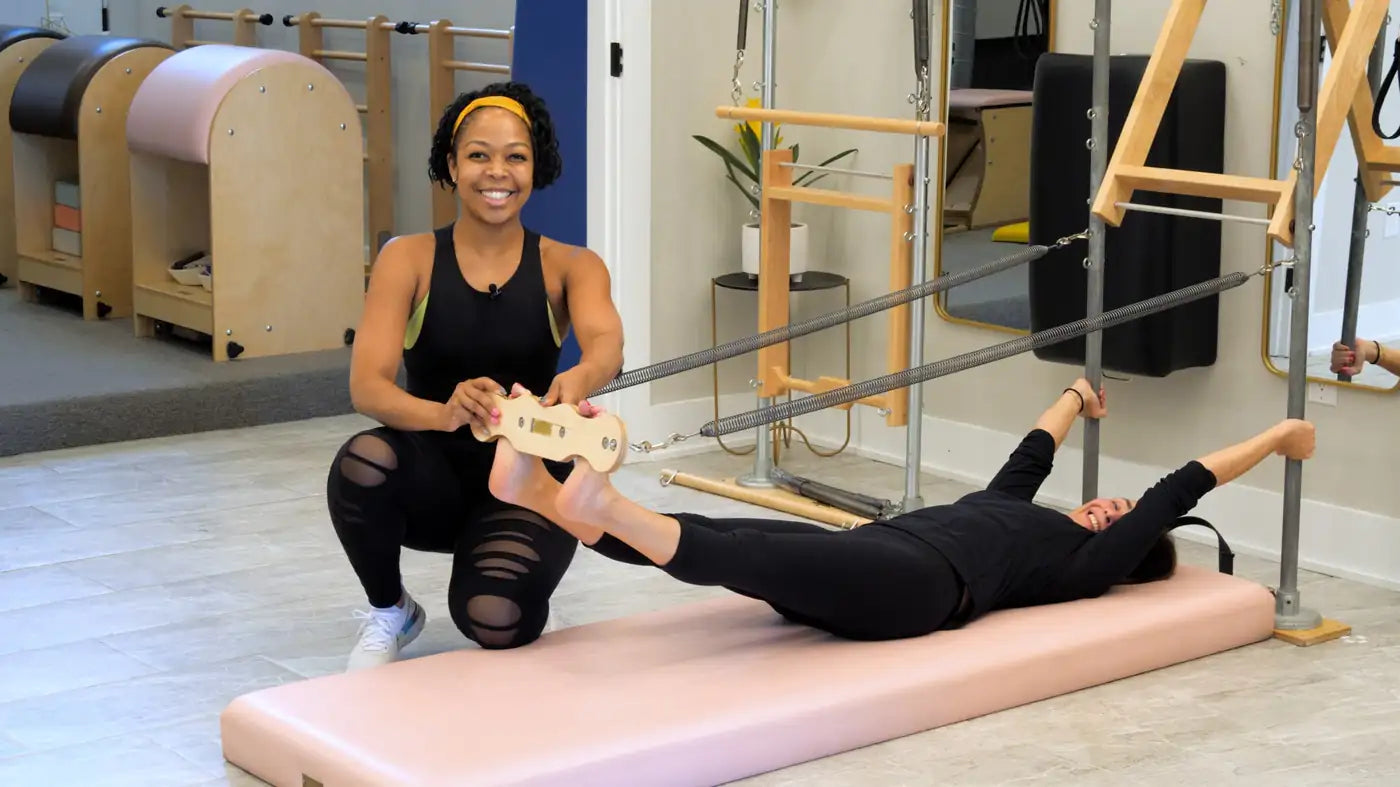
Want to develop strength and symmetry in your hips, legs and glutes? The Gratz Pilates Airplane Board is the device I rely on to do just that. Made to Joseph Pilates exact specifications, it’s a wooden board with foot loops that looks a bit like a torture device but when attached to leg springs on the Cadillac, Tower or Guillotine is actually used to build powerful stability throughout the lower body.
Why Use the Airplane Board?
-
Solid footing & alignment
Unlike foot straps alone (as used in traditional Leg-Spring work), the solid wood surface of the Airplane Board gives you a firm “ground” under your feet and that helps your legs stay aligned, even when you invert or lift.
-
Clear feedback
The board shows you if one of your legs, hips or glutes is weaker or less coordinated so you can focus on it so you can develop equal strength, stability, and control through both legs.
-
Safer journey toward inverted work
Practicing the Airplane exercise using the stable base that the board provides gives you a smart, supported transition into more advanced work on the Cadillac or Tower especially as you eventually progress toward overhead or inverted exercises.
-
Greater control & intention
Because your feet are secured and stable, your attention can shift off “holding on” and instead land squarely on core engagement, spinal articulation, breath, and precision, all hallmarks of classical Pilates technique.
Two-Loop vs. Three-Loop: What’s the difference?
The Airplane Board seen in most studios today is the two-loop version and is commonly used to teach stability and alignment in basic exercises like Frog on the Cadillac. If a student has less strength in one leg, they can immediately feel it and put more effort into the weaker side.
The three-loop version is built for practitioners and instructors who want enhanced foot stability, it includes an additional loop that increases control and clarity. It offers greater security during spring-driven movement.
At a more advanced level, the board is also used to develop the glute strength needed for hips overhead movements such as the Airplane exercise. This movement requires strong and ‘awake’ glute muscles in order to achieve the hip extension needed to lift your body off the mat. By pressing your feet into the board, you can feel your glutes turn on much better than when pressing into wiggly separate foot loops and a stronger side is much more apparent. Just practicing this action is a deep strengthener.
If you’d like to try it yourself, here’s are two videos that give a variety of exercises featuring the two-loop version
Amazing Airplane Board
In this session, teacher Nicole Smith works solely with the Airplane Board (and a Roll-Back Bar), giving a clear demonstration of how to integrate the board into a fluid, strength-focused practice.
Airplane Board How To
This video demonstrates why the airplane board is more effective than foot loops when building stability and coordination, she provides safety tips and a comprehensive example of exercises to use it for.
The Three-Loop Airplane Board
Unknown to most teachers and Pilates practitioners, there is also an Airplane Board with a center loop. Originally found in Joseph Pilates archives with a single loop in the middle of the board, Gratz Pilates manufactures a three-loop board with the extra loop in the center. This board is used for a series of fantastic standing exercises that are documented in Joseph Pilates’ archives. You can see these exercises demonstrated in this Pilatesology video:
The 4 Airplane Boards
This class is a rare archival glimpse into the history of the Airplane Board: it explores four different boards (including three other “unknown” variations in addition to the one most commonly in use today), offering valuable context about what the original setups looked like and how each board might feel underfoot. You’ll also see many of the original exercises demonstrated with detailed cues, alignment tips and safety information.
How the Airplane Board Fits into a Balanced Pilates Practice
For those of us who love the clean, thoughtful approach of Classical Pilates (centered on breath, alignment, control, and flow), the Airplane Board is a subtle but powerful tool. It bridges mat-based strength and control with apparatus-based precision and challenge. In my own teaching and practice, I see it as a perfect complement to the fluidity of mat work and the more structured resistance of Reformer or Cadillac, offering a “third path” that blends support, alignment, and dynamic movement.
I love recommending it to students who are frustrated with keeping their legs on the mat during the Roll Up or can’t seem to find liftoff in hips-over movements. Once the board becomes part of your repertoire, you may find that overhead work, inversions, and leg-spring sequences become more accessible — with greater control, awareness, and joy
Want to dive deeper? Pilatesology is offering Gratz fans an exclusive 30-day free trial. Use the code GRATZ30 when you sign up here and explore hundreds of classes, including more Airplane board workouts like those shared above, taught by the world’s top instructors. It’s the perfect way to experience the full breadth of the Pilates Method right from home.
About Alisa Wyatt
 Alisa Wyatt is a lifelong Pilates teacher, performer, and movement enthusiast known for making the classical method accessible, joyful, and transformative. As co-founder of Pilatesology, she shares authentic Pilates with students worldwide and is passionate about preserving Joseph Pilates’ original work. Alisa has trained and taught extensively on Gratz apparatus, which she considers essential for experiencing the true depth and power of the method, and she loves helping practitioners discover how these classical tools can transform their bodies and lives.
Leave a comment
Comments will be approved before showing up.